
Remember the days when we’d scour through a list of Google links to find the info we were after? It’s crazy how fast things can change in the world of online search.
According to McKinsey, 50% of consumers are already using AI-powered search, making it the most preferred source of information among online users.
For businesses hoping to be found by those users, understanding AI search visibility is everything. And it’s not the same as traditional SEO.
In this article, we’re sharing the inside info on generative engine optimisation (GEO). By the end, you’ll have a much better idea of what it is, how it works, and how to build a GEO strategy that gets you cited by AI search tools.
Understanding GEO
What is Generative Engine Optimisation (GEO)?
Before we dive into the nitty-gritty, let’s get clear on the basics.
Generative Engine Optimisation (GEO) is about making your website and content easier for AI-powered search tools to find, understand, and reference when they’re generating answers.
Here’s an example:
In the pre-AI days, someone looking for CRM software for their B2B brand would jump onto Google and search something like “best CRM software”, then sift through 10+ links.
Today, that same searcher is likely to pull up ChatGPT and ask “what’s the best CRM for a B2B startup?”. Instead of a bunch of links, the AI tool will offer a complete answer that pulls together info from multiple sources.
GEO is about making sure your content is one of those sources.
Why does GEO matter?
Because the way people search is changing.
They’re asking longer, more specific questions. They’re expecting direct answers. And increasingly, they’re getting those answers from AI rather than a list of blue links.
For B2B brands, that could mean being discovered while a buyer is researching solutions or comparing vendors.
For not-for-profits, it might mean helping someone find reliable advice, community services, or educational resources.
If AI tools can’t clearly understand what you do or why they should trust you, they’re less likely to cite you in their responses.
What’s the difference between GEO, AEO, AIO and SEO?
If all those acronyms have got you saying “WTH?”, here’s a quick refresher on what these letters actually mean (hint: they’re not all that different!).
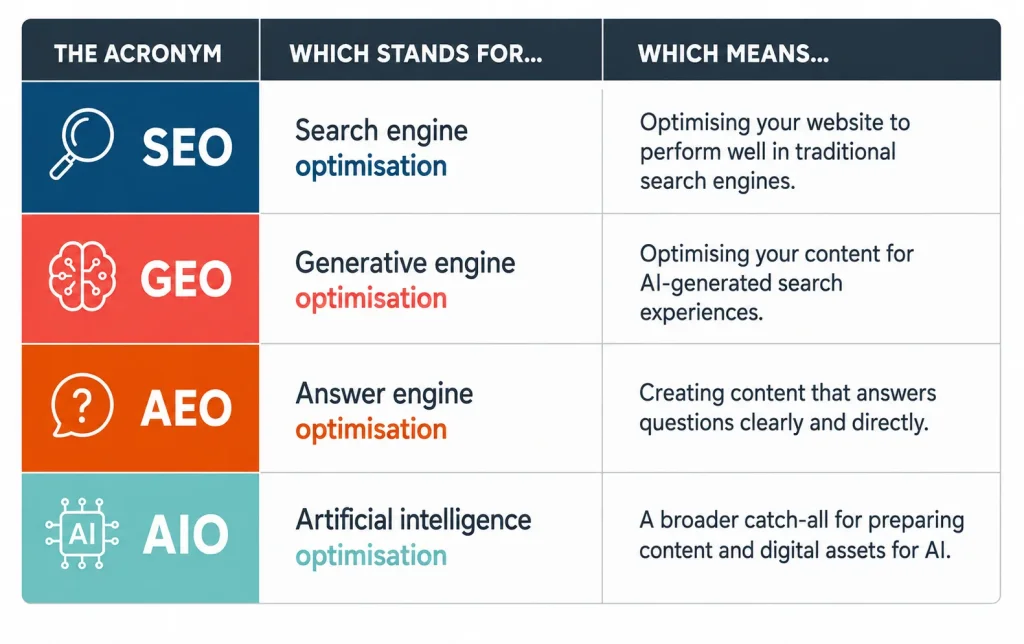
Essentially, while the platforms may have changed, this is still about creating content that’s designed to be found online.
(So if you’re already invested in strong SEO and solid content, you’ve got a head start in the AI search game.)
Is GEO replacing SEO?
Despite the clickbait-y cries of a thousand LinkedIn posts, traditional SEO is not, in fact, dead.
For starters, many people are still using search engines like Google, especially for local searches.
Secondly, good SEO is basically the foundation of GEO.
All those things that are important to SEO – like high-quality, relevant content, a well-structured website, and robust technical performance – matter just as much for GEO.
Think of it this way: if SEO helps search engines find your content, GEO helps AI tools understand what that content says, and whether it’s credible enough to be used in an answer.
How GEO Works
How do AI search tools decide what information to use?
You might think that AI search tools are simply glorified search engines, grabbing the top links from Google and regurgitating the information they contain. But that’s not how they work.
To provide you with an accurate answer, an AI tool will generate a detailed response based on a wide range of sources that it deems credible and trustworthy.
Those sources will certainly include websites, but they’ll also include information from other channels – such as user-generated content, online forums, academic research, and social media platforms.
So how does an AI tool decide what content to include in its answer? While the jury’s out on the exact process, one thing we know for sure is that ChatGPT and co are generally looking for content that’s:
- Relevant
- Clear
- Accurate
- Well supported
- Consistent
- Helpful
In very basic terms, the better your content is at genuinely answering a question, the easier it becomes for AI to understand and use.
What actually improves AI visibility?
While the method of AI-powered search tools can be head-scratchingly complex, the underlying focus is pretty straightforward.
AI visibility tends to improve when you consistently produce content that’s easy to understand and difficult to argue with.
That usually means:
- Explaining exactly what you do.
- Demonstrating genuine expertise.
- Backing up claims with evidence.
- Publishing original insights.
- Keeping information current.
- Building authority in your industry.
- Organising content logically.
It’s not exactly groundbreaking stuff, but it shows that in search, simple is often best.
“Adding statistics to content is the single most effective GEO tactic, improving AI visibility by 41%.”
Source: https://ziptie.dev/blog/how-original-research-wins-ai-citations/
Getting Cited by LLMs
How do you optimise content for AI search?
First, a quick reminder of how not to optimise for AI search.
As tempting as it may be to pump out a constant stream of stiff, robotic content stuffed with awkward questions, this is unlikely to help you win the AI search race.
Original, authentic, and genuinely relevant content beats AI slop any day. It really is a case of quality over quantity.
Here are some quick tips to give your AI search visibility a leg-up:
1. Answer the questions your audience is asking
Your prospects have questions – and they’re asking their fave AI tool for the answer.
Structure your content in a way that answers those queries, and you’ll have a much better chance of showing up in the AI answer.
TL;DR: Short keywords are out; conversational questions are in.
2. Give a clear answer early
Don’t make your readers dig through five paragraphs of text to get to the point.
Answer the main question near the top of the page, then add detail, examples, and extra context underneath.
This makes the content easier for people to scan and easier for AI systems to interpret.
“44.2% of all LLM citations come from the first 30% of content: the introduction.”
Source: https://www.omnibound.ai/blog/generative-engine-optimization-statistics
3. Let your experience shine
Just like humans, AI tools value original perspectives and first-hand experiences.
Include originality signals like proprietary research, case studies, expert commentary, and industry-specific insights to help you stand out in a sea of generic content.
Make it new, interesting, and useful, and AI will (probably) reward you for it.
4. Support your claims
Made a factual claim? Show where it came from (and make sure it’s legit).
Reference credible research and statistics, reliable industry sources, and up-to-date data any time you incorporate facts or stats in your content.
This will help both AI and your audience feel confident that what you’re claiming is the real deal.
5. Structure the page clearly
AI tools aren’t big fans of messy, unstructured content (and, let’s face it, nor are humans).
Use clear headings that reflect the question or topic being covered, keep paragraphs short and focused, and make content easy to scan with lists, tables, and step-by-step guides.
Content that’s simple to navigate gives AI tools solid clues about how everything fits together.
6. Tell AI what you’re all about
Not to bruise your ego, but AI probably doesn’t know who you are.
Use your website and content to clearly explain:
- What your organisation does
- Who it helps
- Which industries or communities it serves
- What topics it has expertise in
- Who created or reviewed the content
Author bios, expert profiles, and links to related pages can all help provide the kind of context that AI tools go crazy for.
7. Connect related content
A strong piece of content should be the start of a journey, not a dead-end.
Use internal links in your articles and webpages to direct AI tools to other related content, whether that’s a service page, a case study, or a how-to guide.
This signals your expertise across a topic or service area and lets AI explore your connected content.
8. Keep it accurate and current
A compelling statistic from ten years ago isn’t all that compelling.
Keep your content current and timely by reviewing key pages regularly, updating old statistics, removing broken links, and revising outdated advice based on recent developments.
Fresh, up-to-date content is much more relevant and useful – and that’s great news for AI tools.
“AI-cited content is 25.7% fresher than content in traditional organic search results.”
Source: https://www.omnibound.ai/blog/generative-engine-optimization-statistics
What types of content work well for AI search?
If the objective is to answer questions, you need content that lends itself to this goal.
Thin, poorly-researched, or “fluffy” content won’t cut it. Getting noticed and cited by AI search tools means upping your content game and creating genuinely useful assets that satisfy your audience’s burning queries.
What does that include? Things like:
- In-depth guides that go beyond the surface-level stuff
- FAQ-style content that explicitly answers questions
- Comparison and “best of category” guides for BOFU-stage readers (like this one)
- Original research and statistics
- Case studies and project showcases
- Industry explainers with unique perspectives
Detailed, original content that takes the reader from unclear to in-the-know is always your best bet.
Does schema markup help with GEO?
Yes, but with a small caveat.
Schema signals to search engines and AI tools what they’re looking at – things like content type, author, FAQs, and your organisation.
This is super-helpful to our AI friends and definitely important to include in your content.
But it’s only valuable to your AI search efforts when it’s combined with the kind of high-quality content we’ve been discussing.
Sadly, there are no shortcuts to getting to the top of the AI citation pile.
How important are authority and brand reputation for GEO?
In the AI search world, reputation really matters.
AI tools don’t assess your business in isolation. Instead, they look at the bigger picture to build an idea of how credible, respected, and trustworthy you are in your industry and to your customers.
To do this, they’ll consider things like:
- Industry recognition
- Backlinks
- Media coverage
- Research
- Awards
- Expert authors
- Consistent brand information
- Independent reviews
AI search tools really want to see that you genuinely know your stuff – so building your online “street cred” is a key part of a GEO content strategy.
How can you measure GEO performance?
This is one of the trickiest parts of GEO activity. Because unlike traditional search engine performance, GEO success doesn’t always come with clear metrics like website clicks (in fact, 93% of searches using Google’s AI Mode are zero-click).
To understand whether your GEO efforts are working, you’ll need to look at a mix of signals, such as:
- Brand mentions in AI responses
- Referral traffic from AI platforms
- Organic visibility for educational content
- Branded search growth
- Share of voice across important topics
- Leads generated from informational content
It’s also worth remembering that AI responses can change from one day (or one prompt) to the next. Rather than obsessing over individual questions, aim to become a consistently recognised source of expertise.
Combine Your GEO Strategy With Genuinely Awesome Marketing
If you’re looking to grow your online visibility, attract the right customers, and build an all-round kick-ass brand, you need a marketing agency that knows its stuff. Oh hey, that’s us.
Reach out to our super-friendly team for a chat about what we can do, or book your free 30-minute strategy workshop with one of our senior strategists.