How many times have you come across an intriguing video on Instagram but were unable to watch it properly because you happened to be in a noisy public space, and the video didn't have any captioning?
You probably put your phone down, thinking that you’d revisit the video later. Chances are though that after some time had gone by, watching it slipped your mind and priority list.
Now, imagine a deaf person who lives this reality everyday, and not just in public spaces, but in the comfort of their own home.
These two examples demonstrate a lost opportunity for marketers to reach their audiences. It also shows marketers’ lack of awareness on how to produce accessible content that caters to all situations, and reaches people with disabilities.
In fact, 1 in 6 people in Australia are estimated to live with a disability, or 4.4 million people. Globally, disabled people reach 1 billion, or around 15% of the population.
Marketers that don’t design inclusive content lose out on many potential leads and ultimately harm their organisation’s bottom line.
Accessible content relates to the wider subject of DEI in marketing. So what exactly does DEI mean for marketing and how can marketers make sure their content is accessible and inclusive?
Defining DEI, Accessibility and Disability
In our article, The cost of treating DEI like a campaign, we explored why Diversity, Equity and Inclusion (DEI) needs to be embedded into an organisation's culture and everyday practices, rather than treated as a standalone initiative.
But what does DEI mean for marketing, and how can organisations put these principles into practice through more accessible and inclusive content?
Diversity, Equity and Inclusion
To briefly recap, one useful description defines DEI as:
“organisational frameworks that promote the fair treatment and full participation of all people, particularly groups who have historically been underrepresented or subject to discrimination on the basis of identity or disability.”
Accessibility
Accessibility is defined as the quality of being able to be reached and used easily, or being able to be used by everyone.
Disability
Disability has undergone several definitions over the years.
The ADA defines it as “a physical or mental impairment that substantially limits one or more major life activities, a person who has a history or record of such an impairment, or a person who is perceived by others as having such an impairment.”
Another, more holistic, definition is provided by the WHO as “the function of the mismatch between a person's abilities and the demands of the environment.”
This views a person not as impaired, but as unprepared in the environment that surrounds them.
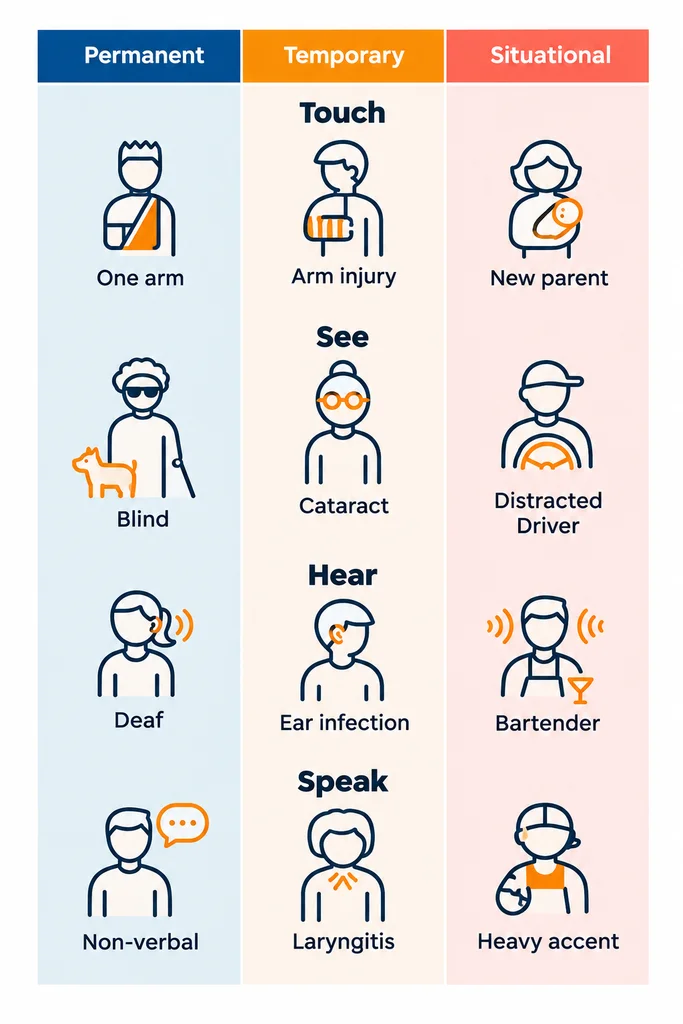
Not all disabilities are permanent. People can become disabled temporarily as well from injury, age, the environment or other situations. Whether or not someone’s disability is permanent, it still should be seriously taken into account.
Why Is DEI Important For Marketing?
While its significance is widely acknowledged in internal company policies, DEI also extends its influence to marketing strategies.
Not only is inclusive and accessible marketing extremely beneficial for organisations and businesses looking to make more profit, it is simply the right thing to do. Moreso, in many countries, it is the law.
Just like physical public buildings that are designed to accommodate those with wheelchairs or limited mobility by constructing ramps and elevators, content should be held up to the same standard.
Inclusive marketing helps break down barriers that otherwise limit some of your audience from accessing your content. Not only is that beneficial for your clients, it also shows them that you care about their needs, and design content that guarantees an equal experience for all.
Ultimately, word of mouth is the most powerful way to market. If you establish a reputation that is inclusive and considerate, people are more likely to talk positively about your brand, and remain loyal to your products and services.
How To Develop Accessible Content
Developing accessible content might seem like a challenge, but there are steps you can take to market inclusively and consider your audience's needs.
- Put Accessibility First: Marketers and designers should consider accessibility at the very start of a project, instead of running through a last minute check-list once the content has already been created.
By doing this consistently, you’ll establish this as a best practice and set up your business or NFP, as well as your audience, for success. - Understand Your Audience: Conduct research using data analytics and customer profiles to gain a better understanding of your target audience, and to start building a framework of your audience’s demographics, their demands, their needs and their expectations.
- Ask Questions: As knowledgeable as you might be, you’ll always have some form of unconscious bias and this typically plays out quite frequently in relation to disability.
The best thing you could do is directly ask your audience questions via surveys, email or even in person.
Conducting accessible content testing sessions with your audience, and making immediate corrections based on their feedback will help you accurately create inclusive content, while avoiding countless back and forth corrections in the long-run. - Hire Professionals: There are many consultants or professional agencies that specialise in accessible content and inclusive marketing.
Make It Happen has worked with NFPs that serve communities in East Kimberly, one of the northernmost regions in Western Australia, with a 40% aboriginal population.
By collaborating on content development, linguistics and images that appeal to diverse demographics, we were able to provide expertise on what would be most engaging and accessible for these particular communities.
Technically, accessible content can take on many different forms. Whether it is developing infographics instead of plain text for people with visual impairments, or creating short-form video content (with closed captioning) that does not take a long time to consume, or choosing appropriate language to make your audience feel safe, the possibilities are plentiful.
Ultimately, it's all about inclusive design, not exclusive content.
Final Thoughts
As businesses and non-for-profits recognise the importance of DEI in marketing, they are integrating these principles into their core strategies.
From equitable representation to accessible content and tailored messaging, DEI is shaping how companies connect with their audiences.
By acknowledging and embracing the diversity of the world we live in, organisations can foster stronger connections, create meaningful impact, and pave the way for a more accessible future.
If you are looking to implement DEI practices into your marketing strategies but still have questions, or don’t know where to start, book a free 30 minute marketing consultation with us today!