You open LinkedIn, and every scroll brings you a fresh wave of déjà vu:
“In today’s fast-paced digital world…”
“Here are five ways to boost productivity with AI…”
“Here’s the thing…”
“It’s not X, it’s Y…”
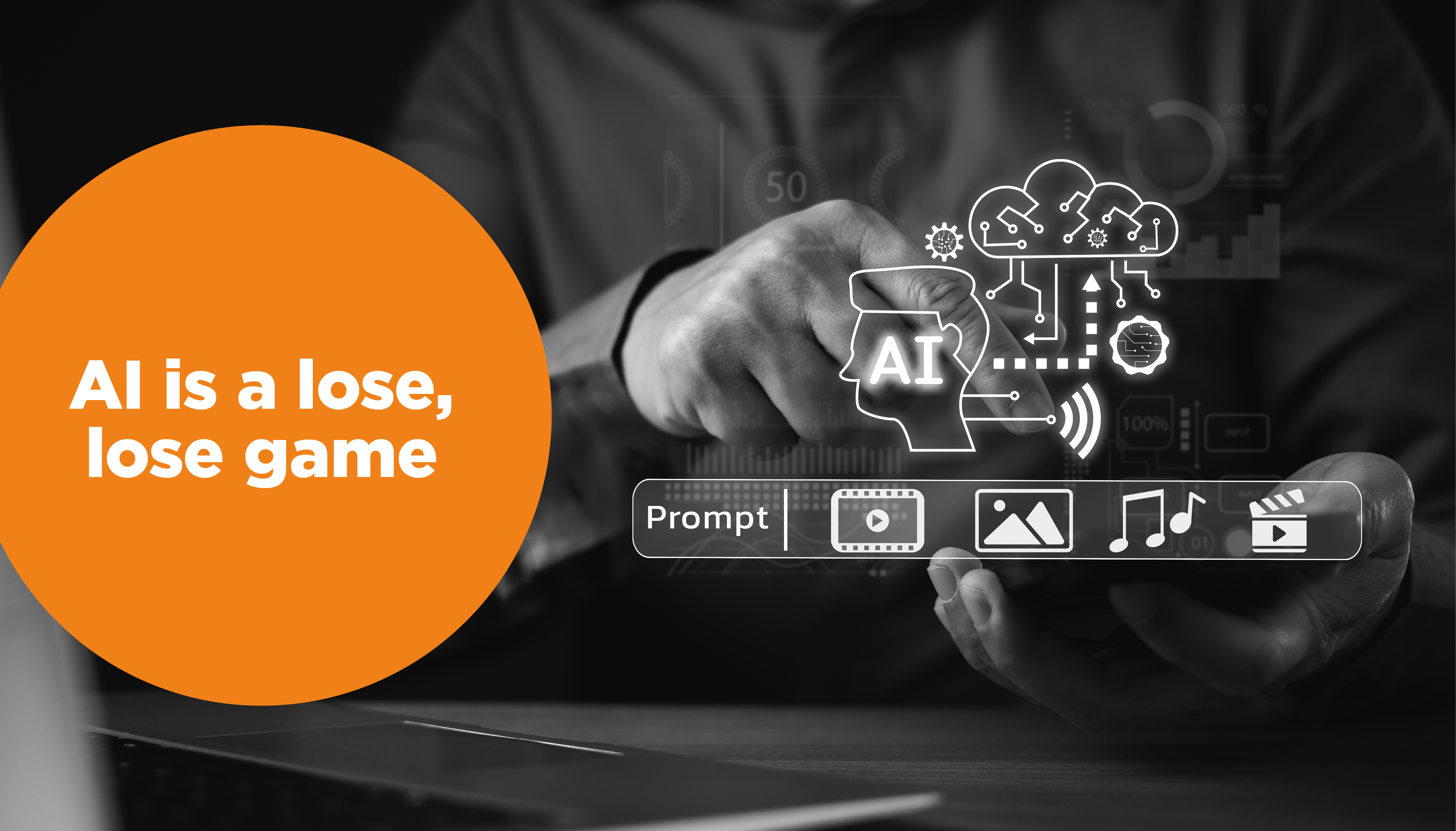
That’s what happens when everyone’s using AI for their content - and that’s far from the only thing people are using AI for. On paper, an AI content strategy looks efficient. Why spend hours drafting when you can generate something in seconds? But efficiency isn’t the same as effectiveness. And while capitalism would have all of us believe that exponential efficiency is the ultimate goal of business, we would argue that freedom of choice and scale of impact are just as important as financial gains.
Back to AI content.
What happens when your “unique” thought leadership reads exactly like your competitor’s? You disappear. While we’re not the biggest fans of AI here at MIH, purely in the context of marketing, AI isn’t making bad marketing. It’s simply allowing people who were already looking for shortcuts to create more bad content at scale. In short, treating AI-generated content as a replacement for originality is what’s dangerous.
Human creativity is still the only thing that can give your brand voice integrity and make your message memorable.
What AI can (and can’t) do for marketing in 2026
AI is everywhere in marketing right now. Scroll through industry headlines and you’ll see endless articles about how brands are “leveraging AI” to save time, cut costs, and automate creative work. On the surface, it sounds like a dream. Who wouldn’t want a marketing department that never sleeps, churns out assets on demand, and does it all in seconds?
AI can generate copy, images, and even campaign ideas. But what it can’t do is create something worth noticing. It can’t understand culture. It can’t feel an audience’s frustrations, hopes, or lived experiences. It can’t sense when a brand’s tone is off, or when a campaign idea is so predictable it will fall flat before it launches.
In an attention economy, it can’t create something worth noticing. Something that evokes emotion.
But the concerns go beyond accuracy. It’s the lack of originality and cultural relevance in AI-driven outputs. In other words, speed without substance.
The danger isn’t just bad copy. It’s bad marketing. When brands rely on AI as a strategy, the outputs start to converge. The results become a sea of sameness: generic campaigns, soulless customer journeys, templated slogans. This is what I call the content sameness tax. You save time, but you pay in invisibility. And sameness is expensive.
Marketing has never been about doing more, faster. It’s about creating meaning. And meaning doesn’t come from machines.
The sameness tax: why AI-generated content blends into the feed
If you’re choosing to disregard the ethical and environmental issues, the other problem with AI-led marketing isn’t that the outputs are wrong. It’s that they’re indistinguishable.
AI may give you efficiency, but it strips away the one thing people actually notice: originality. Yes, there’s the issue with AI ‘hallucinating’ and making up information, statistics, and references. But the less spoken-about issue is that it produces what psychologists call fluent but shallow outputs.
They sound right, but they don’t say anything. That might work for filler content, but it’s disastrous for thought leadership. As noted by Psychology Today, AI’s fluency masks a deeper cognitive blind spot: coherence doesn’t equal understanding. That might sound polished, but it’s disastrous for work that requires real insight or trust.
When every brand leans on the same tools and the same “fast hacks,” they all end up sounding and looking alike.
When your message could have been written by anyone, why should a customer choose you?
You don’t have to look far to see it in action. Generic social ads that open with the same tired phrases. Blog posts that start with “In today’s fast-paced world…”. Brand taglines that could belong to any company in the industry. It’s not just boring, it’s invisible.
Overreliance on AI risks creating “content wallpaper” – material that fills feeds but fails to spark attention or trust. Psychology explains why this happens. Humans are wired to crave novelty. Neuroscience research shows that the brain releases dopamine when it encounters something unexpected, which makes us more likely to notice, remember, and share it (Nature Neuroscience). Generic AI outputs strip away novelty in favor of predictability. That’s why campaigns built on shortcuts rarely break through. They’re neurologically forgettable.
Shortcut marketing, whether it’s AI reliance, templated strategies, or copy-paste creative, robs brands of that connection. And in a crowded marketplace, invisibility is the most expensive mistake you can make.
Why shortcut marketing erodes trust and results
Marketers often defend shortcut strategies, whether that’s overusing AI, recycling templates, or running copy-paste campaigns. by pointing to efficiency. “We got it out the door faster” becomes the metric of success. But the real measure of marketing isn’t speed. It’s whether your work builds trust, creates differentiation, and drives lasting results. And on those fronts, shortcut marketing fails.
Trust is the first casualty. In Edelman’s 2024 Trust Barometer, 71% of people said they lose trust in brands that rely on generic or inauthentic communication. AI-heavy marketing, by its very nature, produces communication that feels hollow– words without fingerprints. If your audience senses your message could have come from anywhere, they’ll subconsciously assume your brand doesn’t stand for anything that matters.
Differentiation is next to go. In a saturated market, sameness is suicide. Although AI adoption in marketing is soaring, are brands really seeing any competitive advantage from it?If everyone has the same tool, no one has an edge. The result is an industry of lookalike campaigns competing for shrinking scraps of attention.
Shortcuts don’t just waste marketing spend. They damage brand equity. And once a brand becomes interchangeable, price becomes the only differentiator left.
Every time you choose efficiency over originality, you teach your audience that you’re interchangeable.
Human creativity and perspective is still your edge
For all the hype about automation, the brands people actually remember don’t win because they were fast. They won because they were different. Originality, not efficiency, is what cuts through.
Think about some of the most memorable campaigns: Dove’s Real Beauty sketches, Carlton Draught’s iconic Big Ad, or even the Old Spice The Man Your Man Could Smell Like series.
None of those ideas could have been generated by AI. They worked precisely because they carried risk, cultural relevance, and a human fingerprint.
Creativity isn’t ego. It’s a business advantage with hard numbers to back it up: creative marketing strategies can bring up to 11x higher ROI than standard approaches. They also bring 37% higher memorability and 68% better brand recall 6 months down the track when compared to standard campaigns.
Psychology explains why. Humans are wired for novelty and storytelling. When a message feels fresh, unexpected, or deeply human, it activates attention and memory in ways that generic marketing can’t. Neuroscientists call this the “novelty effect”: new stimuli release dopamine, which makes people more likely to notice, remember, and share content. That’s why formulaic campaigns fade, while original ideas stick.
Yet in a marketing world obsessed with efficiency metrics, it’s easy to undervalue creativity. Shortcut marketing treats originality as expendable. But it’s the one thing competitors can’t copy-paste.
A recent Harvard Business Review article summed it up: “Overall, more-creative campaigns were more effective - considerably so. We also found that certain dimensions of creativity are more effective than others in influencing purchasing behaviour - and that many companies focus on the wrong dimensions in their campaigns.”
For brands that want to lead instead of follow,invest in human creativity. Not just in copywriting or visuals, but in the ideas that shape campaigns, experiences, and brand voices. Because speed can get you noticed for a second, but originality is what makes people care.
Principles for human-first marketing
So if AI isn’t the answer, what is? It’s not about new hacks. It’s about re-committing to the fundamentals of human-first marketing, the principles that competitors can’t copy-paste. Here’s how.
1. Lead with bold ideas, not busywork
Originality doesn’t come from doing more, faster. It comes from asking braver questions, taking creative risks, and putting ideas into culture.
2. Build cultural fluency
AI can remix yesterday’s data. It can’t sense today’s mood. Human marketers are the ones who know when a joke lands, when a phrase feels tired, when a message hits too close to home. Culture moves fast. Only humans can read the room.
3. Protect your brand voice like an asset
Your voice is the fingerprint that makes you memorable. The moment it sounds like everyone else’s, you’ve lost your edge. Invest in sharpening it, documenting it, and defending it from dilution.
4. Measure what matters
Chasing volume metrics—posts per week, impressions, cost per lead—creates the illusion of progress. But creative quality drives far more effectiveness than media spend. Judge your marketing by impact, not just output.
5. Choose the harder path
Anyone can generate “content wallpaper.” Few can craft ideas that make people feel, think, or act. Originality takes longer. It takes more energy. But it’s the only thing competitors can’t steal.
Marketing has always been about meaning, not mechanics. Tools will change. Trends will come and go. But the brands that endure are the ones that double down on creativity, culture, and humanity. In 2026 and beyond, that’s the only strategy worth having.
Final thoughts: Choose originality over shortcuts
Your marketing doesn’t need to move faster. It needs more depth, it needs soul. The brands that win in 2026 won’t be the ones churning out the most content or chasing the latest tools. They’ll be the ones bold enough to sound different, take risks, and put unmistakable humanity and human creativity back at the centre of their strategy.
At MIH, that’s what we do. We build campaigns and voices that can’t be mistaken for anyone else’s. Because in a world of shortcuts, originality is no longer optional.
Ready to trade generic for unforgettable? Book your free 30-minute consultation.